Speech Delay vs Autism — How to Tell the Difference

If you have ever sat across from your child, waiting for them to say “mama” or point at something exciting, and felt that quiet knot of worry tighten in your chest — you are not alone. Thousands of Pakistani parents go through this exact moment every single day. And the question that follows is almost always the same: Is this just a late talker, or is something more going on?
The confusion between a speech delay and autism is one of the most common concerns parents bring to specialists. And honestly? It makes complete sense. Both conditions involve delayed communication and both can look similar on the surface. But underneath, they are quite different — and understanding that difference is the first step toward getting your child the right support.
If you have already started looking for speech therapy schools in Islamabad, you are already ahead of most parents — because early action, even before a diagnosis, is always the right move.
What Is a Speech Delay, Exactly?
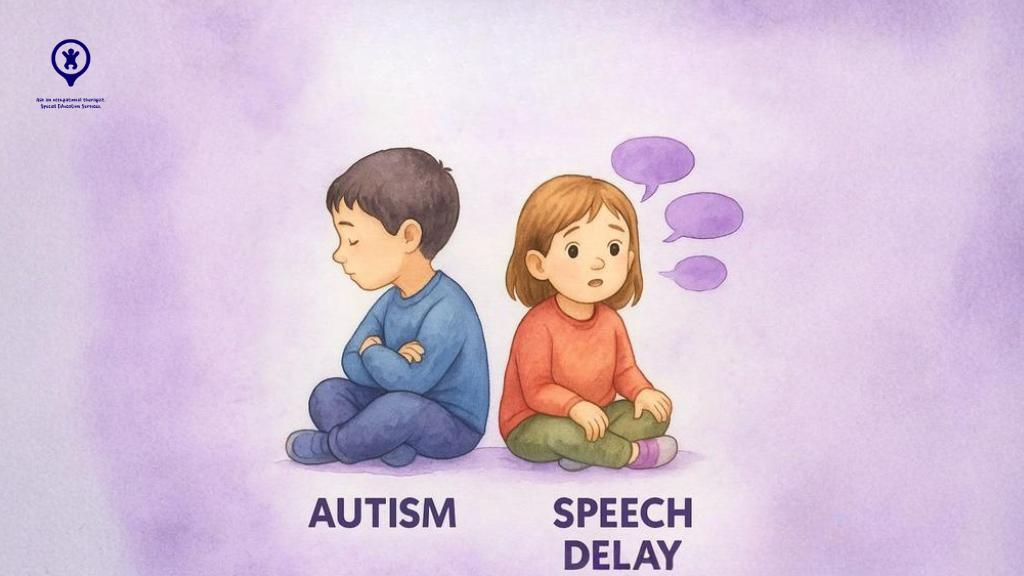
A speech delay simply means your child is developing language skills later than the typical range. Maybe they are not saying words by 12 to 16 months, or not putting two words together by age 2. That is the delay — just the timeline of spoken language being slower than expected.
But here is what most parents do not realize: a child with a pure speech delay is still trying to communicate with you. They point. They pull your hand toward what they want. They make eye contact when something excites them. They wave, nod, shake their head. The desire to connect is absolutely there — they just do not have the words yet.
Think of it this way: a speech delay is like being stuck in traffic. The destination is the same, the driver wants to get there, it is just taking longer than planned.
So What Makes Autism Different?
Autism is a neurodevelopmental condition. And yes, many autistic children do have speech delays — research published in clinical literature confirms that a significant portion of children on the spectrum experience some level of language difficulty. But the key difference is not just when they speak. It is how and why they communicate — or do not.
A child with autism may not respond when you call their name, even though their hearing is perfectly fine. They may not follow your gaze when you look at something. They might not point to show you the airplane in the sky because sharing that moment of excitement with you may not feel the same way to them as it does to a neurotypical child.
Other signs that suggest autism rather than just a speech delay include:
- Repetitive behaviors — hand flapping, spinning objects, lining up toys the same way every single time
- Very rigid routines — an unusual level of distress when things change, even small things
- Limited pretend play — by 18 to 24 months, most children pretend to feed a doll or talk on a toy phone; autistic children may not engage in this kind of imaginative play
- Sensory differences — being extremely sensitive to sounds, textures, or lights, or the opposite — barely noticing them at all
- Echolalia — repeating phrases from TV or conversations without it connecting to what is happening in the moment
If several of these signs feel familiar, reaching out to an awareness centre for autism in Islamabad for a proper developmental screening is a wise and important next step — not something to delay.
The Overlap Is Real — And It Is Okay to Be Unsure
Here is something that will make you breathe a little easier: these two things can exist at the same time. A child can be both autistic and have a speech delay. Or they may have a speech delay caused by something entirely different — hearing loss, oral motor difficulties, a bilingual home environment, or simply being a late talker who will catch up naturally by age 3 or 4.
The core distinction that specialists look for is social communication — how a child seeks connection, shares attention, and responds to others — not just whether words are coming on time. This is precisely why a professional evaluation matters so much more than any online checklist.
If you are unsure whether what you are seeing is a speech delay or something broader, consulting an autism specialist in Islamabad can give you the clarity and direction your family needs — without the guesswork and anxiety of trying to figure it out alone.
What to Watch For — A Simple Parent’s Guide
By 12 months, your child should be babbling, responding to their name, and using basic gestures like waving. By 18 months, they should have at least 6 to 10 words and be pointing to share interest. By 24 months, two-word combinations should be appearing. If your child has lost language skills they previously had, at any age, that is always a red flag worth acting on immediately.
Beyond milestones, watch how your child connects. Do they look at you when they are happy about something? Do they bring you things just to show you — not just to ask for help? Do they respond differently to your face than to a stranger’s? These social behaviors tell you far more than word count alone.
If anything on this list is giving you pause, families in the E-11 area can start with a structured assessment at a speech therapy school in E-11 Islamabad — where trained professionals can evaluate your child’s full communication profile and guide you on what comes next.
Early Intervention Changes Everything
Both research and the lived experience of Pakistani families confirm one thing consistently: the earlier you start, the better the outcomes. The brain is at its most adaptable in the first five years of life, and every month of early support has a ripple effect that can shape your child’s future.
Occupational therapy for children in Pakistan plays a particularly powerful role here — especially for children who have sensory sensitivities, motor challenges, or difficulty with focus and regulation alongside their communication delays. When combined with speech therapy and ABA where needed, it forms a complete support system that addresses the whole child, not just one aspect of their development.
You Are Not Waiting for Certainty — You Are Waiting for Help
The hardest part of this journey is the not knowing. But here is the truth: you do not need a confirmed diagnosis to start getting support. If something feels off, trust that feeling. Reach out to a specialist. Ask for an evaluation. Start the conversation.
Whether your child needs a few months of speech therapy or a more comprehensive intervention plan, the single most important thing you can do right now is take that first step. Because no matter what the answer turns out to be — early action is never the wrong move.