
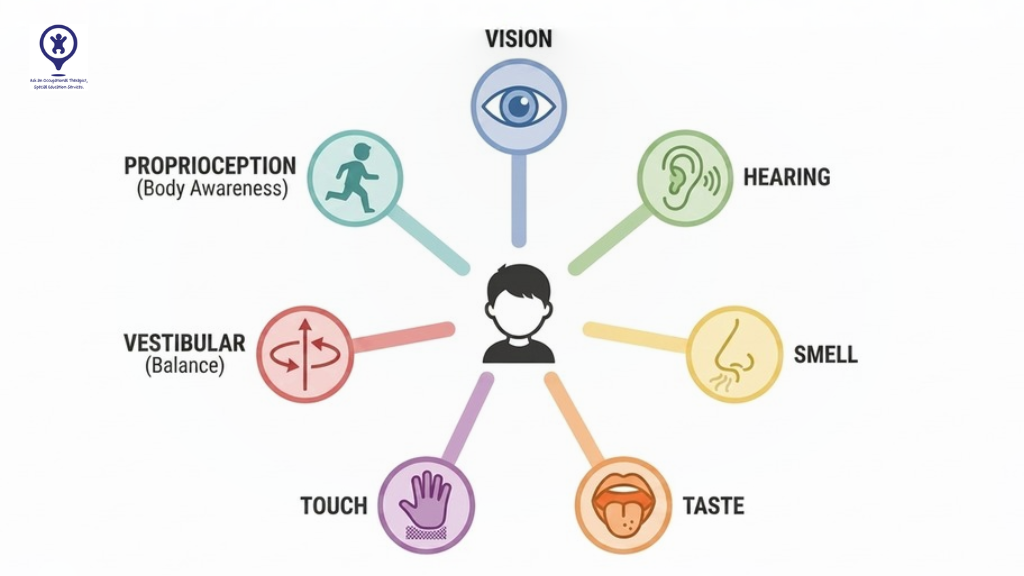

Have you ever watched your child completely fall apart because of a tag in their shirt? Or seen them refuse to enter a room just because of the smell of someone’s food? Maybe your child spins for twenty minutes straight and you cannot figure out why, or they crash into every wall and piece of furniture in the house like they genuinely cannot feel where their body ends. If any of this sounds familiar, you are not dealing with bad behaviour. You are watching a sensory system that is working very differently from most. And once you understand how that system actually works, so much of what your child does starts to make complete sense. For families exploring sensory integration therapy Islamabad, this understanding is usually the moment everything shifts.
What Is the Sensory System and Why Does It Matter
Most people were taught in school that humans have five senses: sight, sound, smell, taste and touch. But that is actually incomplete. We also have two more senses that most people have never heard of, and these two are especially important for autistic children. The first is called the vestibular sense, which lives in the inner ear and tells your brain where your body is in space, whether you are upright, moving, spinning or still. The second is called proprioception, which comes from your muscles and joints and tells your brain how much pressure and force your body is experiencing. Together with the five classic senses, these seven channels of information stream into your brain constantly, every second of the day. Your brain’s job is to organise all of that information, decide what matters and what to ignore, and then produce an appropriate response. For most people, this happens automatically and without effort. For many autistic children, this process does not work the same way. In fact, research published on PubMed Central confirms that sensory processing differences are present in the majority of autistic individuals and significantly affect their daily functioning. Families looking for an autism school Islamabad that understands this difference will find that sensory-aware environments change everything for their child.
What Happens When the Sensory System Is Different
In autistic children, the brain processes sensory information in ways that can be either over-responsive or under-responsive, and sometimes both at the same time in different channels. An over-responsive child feels everything too intensely. That shirt tag does not just feel slightly scratchy, it feels like it is cutting into their skin. The classroom does not just sound busy, it sounds like standing inside a speaker at full volume. A light touch on the shoulder does not feel casual, it feels like a shock. Everything is turned up too loud and the brain cannot filter any of it out. An under-responsive child is the opposite. They do not get enough information from their senses, so they seek it out intensely. That is why they crash into things, spin, squeeze themselves into tight spaces, chew on everything or rock back and forth. They are not being difficult. They are trying to feed a sensory system that is hungry for input. If you want to go deeper on what this looks like day to day, this breakdown of sensory processing disorder and autism from the Autism Testing Institute is one of the clearest parent-friendly explanations available. Every occupational therapist Pakistan families consult will tell you that identifying which pattern your child follows is the very first step toward helping them.
Why School Is So Hard for Sensory-Different Children
Think about what a typical school day asks of a child. They walk into a building that smells like cleaning products and other people’s lunches. They sit under fluorescent lights that hum and flicker. They are expected to sit still on a hard chair for long periods. They are surrounded by noise from thirty other children, chairs scraping, bells ringing, the teacher’s voice, someone coughing. They are expected to manage all of that sensory input while also learning to read and do maths. For a child whose sensory system is already working overtime, this is not just uncomfortable. It is genuinely overwhelming, and their brain is spending so much energy just trying to cope with the environment that there is very little left for learning.Raising Children Network explains this brilliantly in their guide on sensory sensitivities in autism, noting how everyday environments that neurotypical children barely notice can be genuinely painful and disorienting for autistic children. This is one of the most important reasons why autism therapy Islamabad that includes sensory work makes such a visible difference in a child’s ability to cope with school. When the nervous system is regulated, learning becomes possible.
What Sensory Integration Therapy Actually Does
Sensory integration therapy is not about forcing children to tolerate things that overwhelm them. It is about gradually and carefully helping the nervous system learn to process sensory input more efficiently. Think of it like physiotherapy for the brain’s sensory pathways. A therapist will create a personalised programme of activities that gently challenge the child’s sensory system in a safe, playful environment. This might involve swings that provide vestibular input, climbing and crashing activities that feed the proprioceptive system, textures and materials that gradually expand the child’s tactile comfort zone. None of this looks like sitting at a desk. Most of it looks like play. But underneath the play, the nervous system is being trained to respond more calmly and effectively to the world. WBMA’s detailed overview of sensory integration therapy for autism outlines exactly how these structured sensory experiences build new neural pathways over time, which is worth reading before your first appointment. The best therapist for autism in Islamabad will always design this kind of programme around what the specific child’s nervous system needs, not a one-size-fits-all approach.
Sensory Processing and Communication
Here is something many parents do not realise: sensory processing problems and communication difficulties are deeply connected. When a child is in sensory overload, their ability to communicate shuts down. You might notice that your child loses words during a meltdown, becomes completely non-responsive, or is unable to follow simple instructions that they follow perfectly at home in a calm environment. This is not defiance. The brain under sensory stress is in survival mode, and language is one of the first things to go offline. This is why speech therapy schools in Islamabad that work alongside sensory integration therapy tend to produce far better outcomes than either approach used alone. When the sensory system is calmer, the parts of the brain responsible for language and communication have more capacity to function.
What This Looks Like at Home
Once you understand your child’s sensory system, you can start making small changes at home that make a real difference. If your child is over-responsive, look at reducing unnecessary sensory input in their environment. Soft lighting instead of harsh overhead lights. Seamless socks. A quiet corner they can retreat to when things get too loud. If your child is under-responsive and sensory seeking, build input into their day intentionally. Heavy work activities like carrying a backpack, pushing a trolley or doing wall push-ups can calm a sensory-seeking nervous system before it reaches the point of crashing and spinning. An autistic school Islamabad that builds these strategies into the school day sees measurable improvements in children’s ability to learn and regulate.
You Are Not Starting From Zero
Understanding the sensory system is not just for therapists. It is one of the most practical things a parent can learn, because it changes how you see your child’s behaviour entirely. The spinning, the crashing, the meltdowns over tiny things, the refusal to eat certain textures, the constant need for movement, all of it has an explanation and all of it has strategies that help. You do not have to figure this out alone. A good therapy team will not just work with your child in a session and send them home. They will teach you what is happening, show you what to do and build a plan that works across every environment your child lives in. That is what real support looks like, and that is what every family dealing with sensory differences genuinely deserves.