
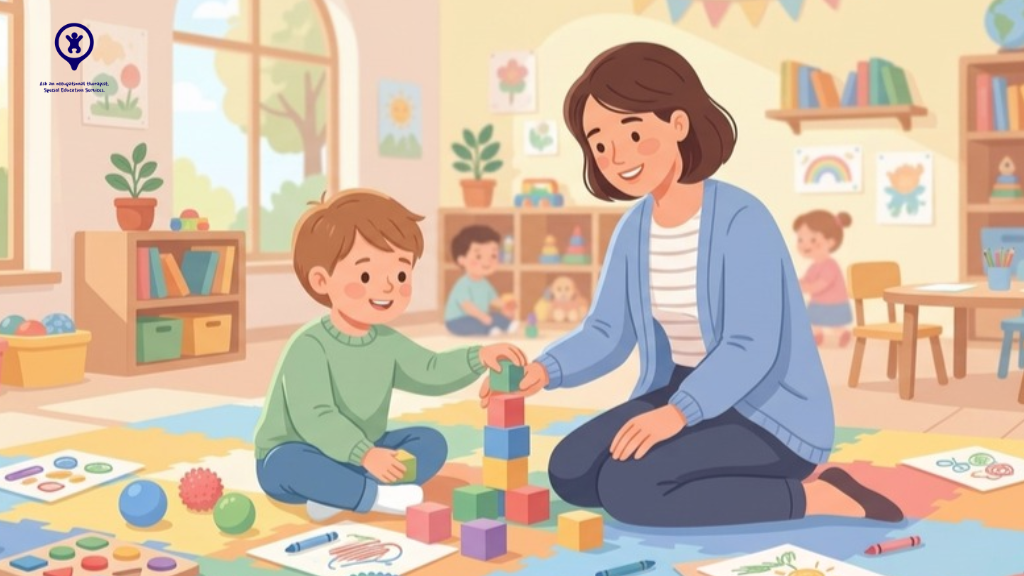

There is a moment every parent knows. Your child is almost four, maybe pushing five, and suddenly everyone around you — aunties, neighbours, the paediatrician — starts asking the same question: Is she ready for school? And without even thinking, your mind goes straight to the alphabet, to counting to twenty, to whether she can hold a pencil. But here is the honest truth that most people do not tell you: knowing your ABCs and 123s is probably the smallest piece of what school readiness actually means. The children who truly thrive on their first day — and their hundredth — are the ones who have built something far deeper than academic knowledge. They have built the inner wiring that lets them cope, connect, and learn.
At AOT, we see this play out every single week. Families come to us worried about flashcards and phonics, and what we gently help them understand is that their child’s nervous system, emotional regulation, and sensory processing need just as much attention — sometimes more. As one early childhood resource puts it, navigating school readiness is really about understanding what matters most for your individual child, and that looks different for every family. If you are looking into a school readiness program in E-11 Islamabad, this is exactly the conversation we want to have with you.
What School Readiness Actually Is
School readiness is not a single skill. It is a constellation of abilities that come together to allow a child to function in a structured environment away from home. Think about what a classroom actually demands: a child must sit still for stretches of time, follow a sequence of instructions from a stranger, transition from one activity to another without a meltdown, manage the noise and movement of twenty other children, and communicate their needs — all before lunchtime.
Experts generally group school readiness into five broad domains: physical health and motor development, social and emotional development, approaches to learning, language and communication, and cognitive development. Notice that academic knowledge sits in just one of those five areas. The rest are about the child as a whole person — their body, their feelings, their relationships, their curiosity. If you want a broader overview of what school readiness skills actually look like in practice, Bright Horizons break it down well.
For families raising children with autism, this picture gets even more layered. A child who is verbal and bright may still struggle enormously with the sensory demands of a classroom. This is something we see constantly at our autistic school in Islamabad — children who are intellectually capable but need specific support to access that potential in a school setting.
The Sensory Piece Nobody Talks About
Walk into any primary school classroom and pay attention to what hits you first — the brightness of the lights, the overlapping voices, the smell of markers and lunch boxes, the hum of the fan overhead. For most children, the nervous system filters all of that background information and lets them focus on the teacher. For children with sensory processing differences, none of that filtering happens automatically. Every single input arrives at full volume, all at once.
When a child is stuck in sensory overload, learning simply cannot happen. It does not matter how many times you have drilled the alphabet — if their nervous system is overwhelmed, that information cannot be processed or retained. This is precisely why finding the best autistic child care centre in Islamabad — one that addresses sensory needs as a genuine priority, not an afterthought — changes everything for these families.
At AOT, our entire approach is built around the idea that a regulated nervous system is the foundation of all learning. Before we teach a child to sit and listen, we help their body learn to feel safe. Before we introduce classroom routines, we help them build the tolerance for transitions. That is not a soft, feel-good extra — it is the most practical thing we can do to prepare a child for school.
Why Emotional Regulation Matters More Than Memorisation
Ask any experienced teacher what makes a child genuinely easy to teach, and very few will say “they knew their letters.” What they actually say, over and over, is: they could handle frustration. They could wait their turn. They bounced back from making mistakes. They asked for help instead of shutting down. These are emotional regulation skills, and they are built slowly, through experience and co-regulation with caring adults — not through worksheets. There is growing global recognition of this — social-emotional learning matters more than ever, and classrooms across South Asia are beginning to catch up with what therapists have known for years.
For children on the autism spectrum, emotional regulation is often the area of greatest need and greatest impact. The families we work with at AOT are frequently told to focus on academics — and we understand why, because the pressure to keep up with peers feels very real. But the best autism treatment in E11 Islamabad is not the one that drills academic content the hardest. It is the one that helps a child develop the internal tools to cope with a world that does not always accommodate them.
Fine Motor and Gross Motor — The Body Matters Too
Here is something parents often miss: a child who cannot hold a pencil comfortably, who tires quickly during writing tasks, or who has poor core strength and cannot sit upright without slumping — that child is going to find school physically exhausting before the academic demands even begin. Fine motor and gross motor development are not optional extras. They are the physical infrastructure of classroom participation.
Sensory integration therapy in Islamabad — the kind that helps a child build body awareness, coordination, and postural control — is one of the most important investments a family can make before school starts. When a child is comfortable in their body, they can direct their attention outward, toward learning. When they are not, all their energy goes into just holding themselves together.
Social Readiness — Can They Be With Other Children?
School is fundamentally a social environment. A child spends six or seven hours a day navigating relationships — with teachers, with classmates, with the child who takes their pencil and the one who wants to share their snack. For many children with autism, this is the most challenging frontier of all, not because they do not want connection, but because the unspoken rules of social interaction are genuinely harder to read.
Structured group therapy, play-based learning, and peer interaction programs are all things we build into our work at AOT’s autism school in Islamabad because we know that social competence is not something that just appears when a child enters the classroom. It needs to be practised in a safe, supported setting first — where mistakes are expected and nobody is judged for needing a little extra time.
What Families Should Actually Do
So what does this mean practically for you, as a parent sitting at home wondering whether your child is ready? It means that the most productive thing you can do is not buy more flashcard sets. It is to look honestly at how your child copes with change, how they manage their body, how they communicate when they are frustrated, and how long they can stay regulated in a busy environment.
If you have concerns — and many families in Islamabad do — the right starting point is an assessment with an autism specialist in Islamabad who can look at the whole child, not just their academic abilities. That kind of comprehensive, experienced perspective changes the conversation entirely. You stop asking “does my child know enough?” and start asking “what does my child need to thrive?” Those are very different questions, and the second one leads to much better answers.
A Final Word
School readiness is not a checklist you tick off in the weeks before September. It is something that builds gradually, across years, through play and routine and relationship and therapy and — most importantly — through a family that never stops paying attention to who their child actually is, not just who the school system expects them to be.
At AOT, we have walked this journey with hundreds of families across Islamabad. We are Pakistan’s first sensory-based therapy organisation, and school readiness — real school readiness — is at the heart of everything we do. Whether your child needs structured ABA support, occupational therapy, speech input, or simply a calm space to grow at their own pace, we are here. You can also read more about how our therapies help autistic children grow and what that journey looks like in practice.
Because the goal was never just to get your child through the school gate. The goal is to help them walk in with their head up, ready for whatever comes next.