

I’ve sat across from so many parents in our center who come in with the same look on their face. That mix of fear, exhaustion, and desperation to understand. Their child has just been diagnosed with autism and the first thing out of their mouth is almost always the same question.
“How bad is it?”
And honestly? I get it. When you’re a parent and someone hands you a diagnosis, the first thing your brain wants to do is figure out what you’re actually dealing with. Is this manageable? What does this mean for school? Will my child ever be independent? Will they make friends?
These are not irrational questions. They’re the most human questions in the world.
The problem is, autism doesn’t come with a straightforward answer. And the word “spectrum” — which doctors throw around constantly — doesn’t really help unless someone takes the time to explain what it actually means in real life. So let me try to do that here.
What the Spectrum Actually Looks Like Day to Day
Forget the clinical language for a second. When we say autism is a spectrum, what we really mean is this — two children can both have an autism diagnosis and look completely different from each other. One child might be in a mainstream school, having full conversations, and struggling mainly when social situations get complicated. Another child might be non-verbal, require support for every daily task, and find a trip to the grocery store genuinely overwhelming.
Both are autistic. Both deserve support. But the kind of support they need is completely different.
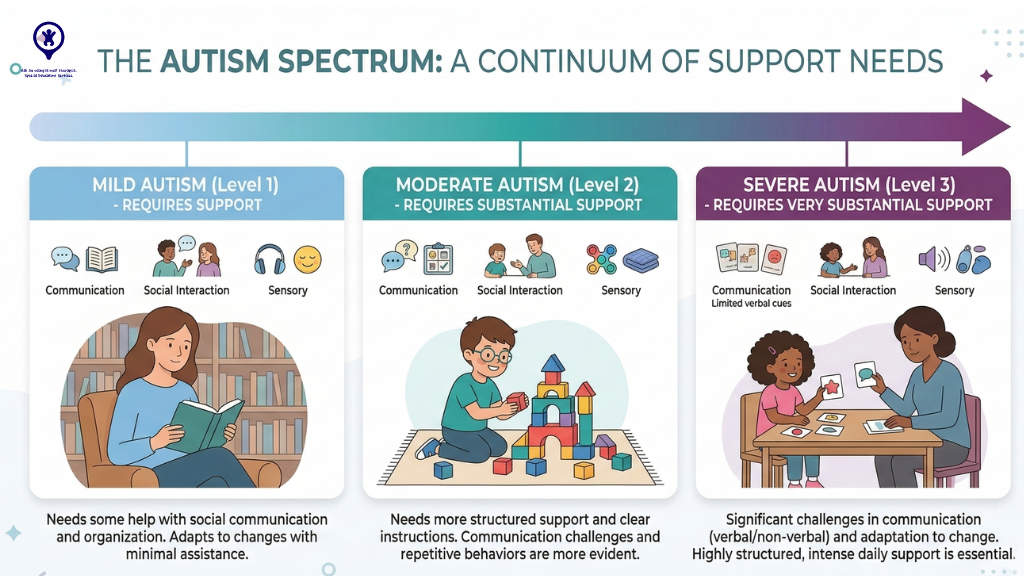
Doctors now classify autism into three levels based on how much support a child needs to function in daily life. If you want a straightforward breakdown of what each level looks like practically,this guide from Little Rays ABA does a good job of laying it out clearly. But let me walk you through each one from our experience working with families here in Pakistan.
Level 1 — Mild Autism
These are children who, on the surface, often seem fine. They talk. They go to school. They can tell you what they want for breakfast and hold a basic conversation. And because of that, their challenges often go unnoticed — or worse, get dismissed.
But spend a bit more time with them and you start to notice things. They struggle in group conversations. They miss the joke. They don’t pick up when someone is being sarcastic or when they’ve said something that upset a classmate. Friendships feel confusing and exhausting for them, even when they genuinely want to connect.
Routines matter a lot to these kids. If something changes without warning — a different route to school, a substitute teacher, lunch at a different time — it can throw off their entire day in a way that seems disproportionate to everyone around them.
These children are often the ones nobody thinks needs help. And that’s exactly why they sometimes struggle the most — because they fall through the cracks.
Early support through occupational therapy for children in Pakistan — sensory work, emotional regulation, social skills practice — can genuinely change the trajectory for a child at this level. Don’t wait because they seem “fine.”
Level 2 — Moderate Autism
At this level, the support needs are more visible. Communication is more affected — some children speak in short phrases, some repeat lines from TV shows or books (this is called echolalia and it’s more common than most people realise), and some find it hard to communicate when they’re stressed or overwhelmed.
Social interaction is genuinely difficult here. Not because these children don’t feel things — they feel everything — but because the tools to connect with other people aren’t fully there yet. They might want a friend but not know how to start that conversation. They might play near other children rather than with them.
Sensory sensitivities are usually pretty significant at this level. Loud sounds, certain textures, fluorescent lighting, strong smells — these things can tip a child into a full sensory overload response. That’s not a meltdown for no reason. That’s a nervous system that’s genuinely struggling to cope with the world.
This is where sensory integration therapy in Islamabad has been genuinely life-changing for so many of the families we work with at AOT. When a child learns to process sensory input more effectively, everything else — behaviour, communication, learning — tends to improve alongside it.
Children at this level usually do really well with a combination of ABA therapy, speech therapy, and a structured school readiness programme that helps bridge the gap between therapy and classroom.
Level 3 — Severe Autism
Level 3 is where the support needs are most intensive. Many children at this level are non-verbal or have very limited speech. They may use picture cards, communication devices, or gestures to express themselves. Daily tasks — getting dressed, eating, toilet routines — often require step-by-step support and a lot of patience and consistency over years.
Repetitive behaviours can be intense and frequent. Transitions — moving from one activity to another, or from home to therapy — can cause significant distress. The world, for these children, can feel like an overwhelming and unpredictable place.
A study published on PubMed comparing parent-reported severe autism with mild and moderate autism found significant differences in daily functioning, communication and support needs between these groups — which reinforces exactly what we see in practice. The needs are real, they are distinct, and they require genuinely different approaches.
Here’s what I want parents of children at this level to really hear though — progress is still possible. It looks different. It might be learning to use a communication device to ask for water. It might be tolerating a car journey without distress. It might be making eye contact during a game. These things are huge. Don’t let anyone tell you otherwise.
If you’re looking for the best occupational therapist near me for a child at this level, find a centre that takes a team approach. You want OT, ABA, speech therapy and family support all working together — not in separate silos.
The Earlier You Start, the Better
This applies at every level. The research is consistent on this — early, targeted therapy leads to better outcomes. Not because we’re trying to change who your child is, but because the brain is most adaptable in the early years and that’s when intervention has the most impact.
For families who want to stay up to date with the latest findings in this space, Autism Research Review International (ARRI) is one of the most reliable resources out there — a quarterly publication from the Autism Research Institute that covers current research in plain, readable language.
At Ask An Occupational Therapist, we’ve been working as one of the leading autism therapy centers in Islamabad for years now. We assess children across all three levels and build individualised programmes that bring together everything a child needs under one roof. As a recognised autism institute in Pakistan, we work not just with children but with their families too — because the progress a child makes in therapy needs to carry over into home, school and community life.
One Last Thing
If you just got a diagnosis for your child — breathe. You haven’t lost anything. You’ve actually gained something really important, which is clarity. You now know what you’re working with. You can stop wondering and start doing.
Mild, moderate or severe — your child is still your child. And with the right support around them, they can grow in ways that will genuinely surprise you.