
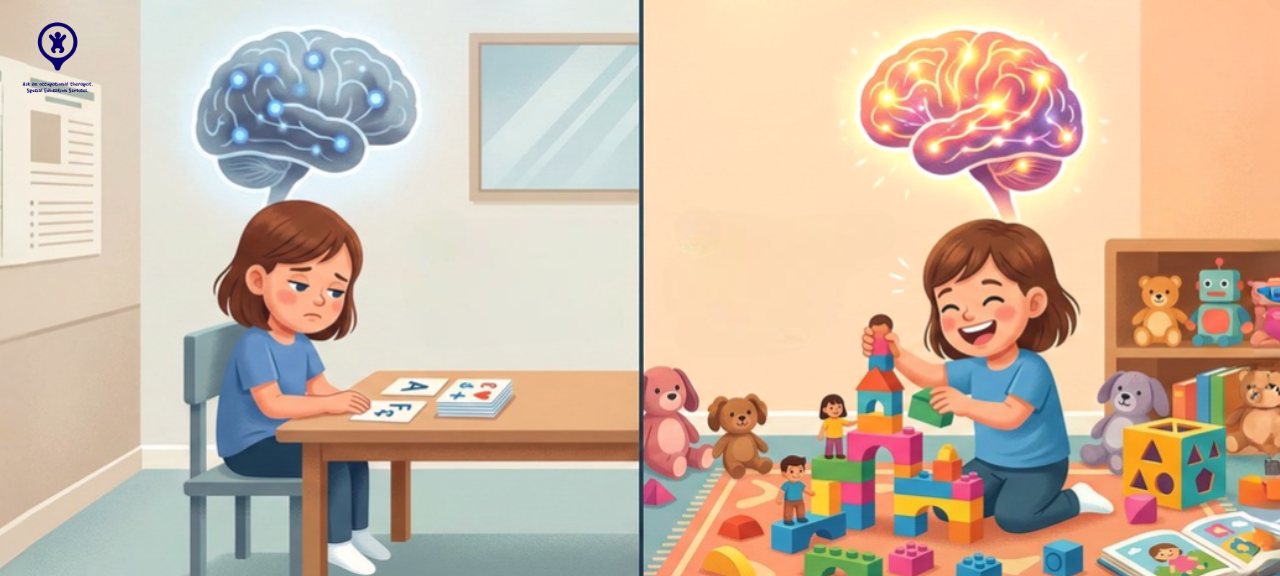

Watch a child at play and you’re watching them work. Every time a child stacks blocks, pretends to cook a meal, or chases a friend around the yard, their brain is firing in ways that no worksheet or flashcard can replicate. Play isn’t a break from learning. For children — especially those with autism or developmental delays — play is the learning.
And yet, for decades, therapy for children looked a lot like school. Sit here. Follow instructions. Do this exercise. Repeat. The child wasn’t always a willing participant, and the results reflected that. Today, a growing body of research and hands-on clinical experience tells a very different story — one where play is the most powerful therapeutic tool we have. As UNICEF notes, play is fundamental to a child’s mental health and overall development, not a luxury but a necessity.
What Play-Based Therapy Actually Looks Like
It doesn’t look like therapy, and that’s entirely the point.
A child rolls a ball back and forth with a therapist. They build a tower together and knock it down laughing. They pour water between containers, dig through a tray of sand, or act out a story with puppets. From the outside, it looks like fun. Inside the child’s brain, something remarkable is happening.
Every one of those activities is developing motor skills, social awareness, emotional regulation, sensory tolerance, language, and cognitive flexibility — all at the same time. Traditional drill-based methods tend to isolate one skill at a time. Play naturally weaves them all together, the way real life does. According to Pediatric Therapy Source, play-based therapy supports children’s development across physical, emotional, and social dimensions simultaneously — something structured instruction simply cannot replicate.
A qualified occupational therapist in Pakistan working with a child through play isn’t winging it. Each activity is carefully chosen based on that child’s specific developmental profile, their sensory needs, their communication level, and where their gaps are. The play is structured with intention, even when it doesn’t look that way.
Why Children with Autism Respond So Well to It
Children with autism often struggle with environments that feel rigid, unpredictable, or overwhelming. A traditional therapy room — a chair, a table, a set of instructions — can feel exactly like that. It creates resistance before the session has even started.
Play changes the equation. When a child feels safe, curious, and in control of what they’re doing, their nervous system relaxes. And a relaxed nervous system is a learning nervous system. Research from George Washington University’s Graduate School of Education highlights that child-centred play therapy creates a therapeutic relationship built on trust and autonomy — allowing children to express themselves and process their experiences at their own pace, on their own terms.
Autism therapy in Islamabad that centres around play doesn’t just make sessions more enjoyable — it makes them genuinely more effective, because the child is actually present and engaged rather than compliant and anxious. There’s also something important about following the child’s lead. When a therapist notices what a child gravitates toward — whether it’s spinning objects, lining things up, or splashing in water — and builds therapeutic work around those interests, the child stops seeing the therapist as someone doing things to them. They become a partner. Trust builds. And with trust comes progress.
The Science Behind Why Play Works
This isn’t just philosophy. The neurological case for play-based therapy is strong.
Play activates the brain’s reward system, flooding it with dopamine — the chemical associated with motivation, memory, and learning. When a child enjoys what they’re doing, they remember it better and are more willing to try it again. Skills practised during play get encoded deeper and retrieved more easily than skills drilled through repetition. A peer-reviewed study published in the National Library of Medicine confirms that play-based interventions produce meaningful improvements in social communication, adaptive behaviour, and emotional regulation in children with autism — with results that outlast those of more structured, compliance-based approaches.
Among the various therapies for autism in Pakistan, play-based approaches are increasingly recognised as producing faster and more durable results precisely because of this. A child who learns to take turns during a game of catch carries that skill into the playground, the classroom, and eventually the workplace. A child who learns to take turns by sitting at a table and being told to “wait your turn” often struggles to transfer that skill outside the therapy room.
Generalisation — the ability to apply a skill in different contexts — is one of the hardest things to achieve in autism therapy. Play-based methods, by their very nature, build generalisation in because they’re dynamic, varied, and joyful.
How Sensory Integration Fits Into the Picture
Many children with autism have a nervous system that processes sensory information differently. A tag in a shirt feels unbearable. A crowded room feels like an assault. Certain food textures trigger genuine distress. These aren’t behavioural choices — they’re neurological realities, and they can get in the way of everything else.
Sensory integration therapy in Islamabad addresses this directly through play. Swinging, spinning, climbing, pushing, pulling, and exploring different textures are all activities that help the brain learn to process sensory input more efficiently. When a child regularly engages in these kinds of activities within a safe therapeutic environment, their nervous system gradually becomes less reactive — and suddenly, the world becomes a less overwhelming place.
This is foundational work. When a child’s sensory system is more regulated, everything else — communication, social interaction, learning, emotional control — becomes more accessible.
What It Means for Everyday Life at Home
One of the most practical advantages of play-based therapy is how easy it is to extend into daily life. Unlike clinical exercises that require specific equipment or a trained professional to guide, play is something every parent can engage in.
Occupational therapy for children in Pakistan delivered through play naturally generates home activities that parents can replicate. A therapist might suggest bathtime games that work on tactile tolerance, or cooking activities that build fine motor skills, or backyard games that develop balance and coordination. As Abundance Therapy Center explains, when parents actively participate in play therapy principles at home, children benefit from continuity that reinforces every gain made during clinical sessions.
Parents become active participants in their child’s development rather than observers waiting for the next session. This continuation between clinic and home is part of what accelerates results. Therapy once or twice a week is valuable. Therapy principles embedded into everyday play, seven days a week, is transformational.
Finding the Right Environment for Your Child
Not every child needs the same approach, and finding the right setting makes a real difference. The best autism center in Islamabad will always start with a thorough assessment — understanding your child’s specific sensory profile, communication level, motor skills, and social development before any therapy plan is created. Play-based therapy isn’t one-size-fits-all. It’s highly individualised, and it should feel that way.
For children who are working toward mainstream education, the stakes are even higher. An autism school in Islamabad that understands the role of play in development will prepare children not just academically, but socially and emotionally — building the whole child rather than just the skills needed to pass an assessment.
Final Thoughts
Children don’t need to be told to play. It’s instinctive, irrepressible, and — as it turns out — incredibly therapeutic. When we meet children where they are, speak their language, and build therapy around what naturally brings them joy, we don’t just see faster progress. We see children who are happier, more confident, and more capable of engaging with the world around them.