
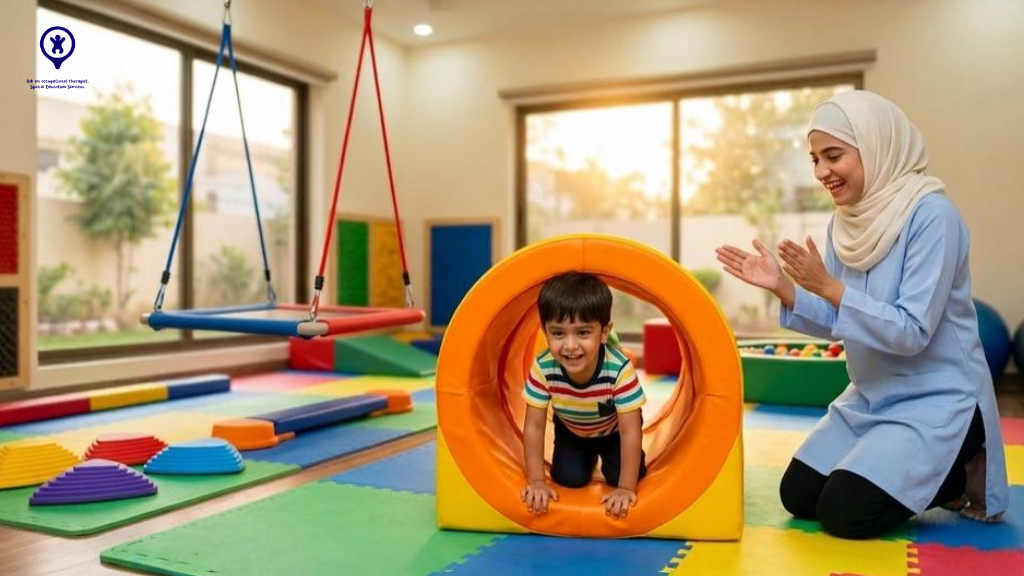

There is a moment almost every parent of a sensory-seeking child knows. You have set up a quiet activity, colouring, puzzles, maybe some reading, and within three minutes your child is upside down off the sofa, spinning across the floor, or bouncing off the walls like the room itself is a trampoline. You are not imagining it. And they are not misbehaving. What you are witnessing is a child whose vestibular system is working overtime, sending signals that their body desperately needs movement to feel organised, calm, and in control.
Understanding the vestibular system, and how to support it, is one of the most powerful things a parent can learn. Whether your child has autism, sensory processing challenges, or simply has what the world calls “too much energy,” vestibular activities can be a genuine game-changer.
What Is the Vestibular System, Really?
Most of us were taught about five senses in school. But the vestibular system is one of the senses nobody tells you about, and it might be the most important one for children who struggle with focus, behaviour, and emotional regulation.
According to NHS Connect’s Vestibular Activities Resource, the vestibular sense is the sensory system responsible for controlling our muscles through balance and movement, and for most of our reflexes. It is stimulated by movement, up and down, backwards and forwards, around or over.
In simpler terms: it lives in the inner ear, and it tells your brain where your body is in space at every single moment of the day. When you walk down stairs without looking at your feet, catch yourself before falling, or feel dizzy after spinning, that is your vestibular system doing its job.
The vestibular system operates through receptors in the inner ear and, in conjunction with position in space, input from the eyes, and feedback from muscle and joint receptors, contributes to posture and the appropriate response of the visual system to maintain a field of vision.
Two Very Different Children, One System
Here is something that confuses many parents: two children can both have vestibular challenges and look completely opposite from each other.
As The OT Toolbox explains in their comprehensive guide on vestibular activities, some children may be hypersensitive to vestibular stimulation and have fearful reactions to ordinary movement activities such as swings, slides, ramps, and inclines. They may have trouble learning to climb or descend stairs and feel apprehensive on uneven surfaces.
On the other extreme, a child may actively seek very intense sensory experiences such as excessive spinning, jumping, and body whirling.
One child refuses to go near the playground swings. Another cannot stop spinning. One trips over their own feet constantly. Another climbs everything in sight without a single moment of fear. Both are experiencing vestibular dysfunction — just at opposite ends of the spectrum.
For children with autism especially, vestibular activities such as swinging, spinning, bouncing, or movements that involve changes in head and body orientation can enhance spatial awareness, postural control, and overall sensory integration. This is not just anecdotal — it is backed by research, and it is exactly why therapies for autism in Pakistan increasingly incorporate vestibular-based approaches as a core part of intervention.
What Happens When a Child Does Not Get Enough Movement
Think about the last time you sat in a chair for three or four hours without moving. That restlessness, that urge to shift, stretch, get up — that is your vestibular system asking for input. Now imagine being a child whose system craves that input ten times more intensely, and being asked to sit quietly at a school desk for six hours.
Vestibular sensory input can be alerting or calming to our nervous systems, allowing us to learn, interact with others, and go through our day. Without adequate vestibular input, children struggle with attention, emotional regulation, and even basic coordination. Behaviour that looks like defiance or hyperactivity often has a sensory root that nobody has identified yet.
According to Middletown Centre for Autism’s Sensory Strategies resource, it is vital that extreme caution is taken when using vestibular activities, as some students can have strongly aversive responses to sensory input. If a child is overresponsive to vestibular movement input, it is strongly recommended to seek advice from an occupational therapist before commencing any vestibular programme.
This is exactly where occupational therapy for children in Pakistan becomes essential.
Vestibular Activities You Can Try at Home
The good news is that many powerful vestibular activities require nothing more than what you already have at home or at your nearest park. Here are practical ideas organised by what they do:
For calming and organising the nervous system:
- Slow, rhythmic swinging on a playground swing
- Rocking back and forth in a rocking chair
- Rolling back and forth on a therapy or exercise ball
- Wrapping in a blanket and gently rocking
For alerting and energising:
- Jumping on a trampoline or bouncing on a bed
- Spinning in an office chair (with supervision and time limits)
- Crawling up and down stairs or slopes
- Animal walks — bear crawls, crab walks, frog hops
For balance and coordination:
- Walking along a rope or tape line on the floor as a balance beam
- Stepping stones made from couch cushions
- Obstacle courses through pillows, tunnels, and furniture
- Hanging from monkey bars or a doorframe bar
For sensory-seeking high-energy children:
Source Kids Australia’s guide on vestibular activities for high-energy sensory-seeking children highlights that crash pads, wheelbarrow walks, rolling down grassy hills, and spinning on tyre swings are among the most effective tools for children who constantly seek intense movement input. These activities meet the nervous system where it is — rather than fighting it.
The key with all of these is to watch how your child responds — not just during the activity, but in the hours after. Vestibular activities should always be tailored to match the individual needs, preferences, and responses of each child.
Why Professional Guidance Matters
Reading about vestibular activities is a wonderful start. But applying them effectively — especially for a child with autism or significant sensory processing challenges — requires the expertise of a trained professional.
Occupational therapists specialise in helping individuals develop and enhance their daily living skills, including sensory integration and motor skills. They perform comprehensive assessments to identify a child’s sensory processing patterns, vestibular sensitivities, and motor challenges. Based on these assessments, they develop personalised intervention plans that incorporate vestibular activities to address specific goals.
At AOT (Ask an Occupational Therapist) in Islamabad, this is exactly what happens. As an autism specialist in Islamabad and Pakistan’s first sensory-based therapy organisation, AOT builds individualised sensory programmes — including vestibular activity plans — that are tailored to each child’s specific needs. Therapies for autism in Islamabad at AOT are not one-size-fits-all. They are designed around the child sitting in front of the therapist, with a clinical eye on what their nervous system is actually asking for.
Occupational therapy in Pakistan has come a long way, and families no longer need to travel abroad to access world-class sensory intervention. The tools, the expertise, and the compassion are right here.
Final Thoughts
Movement is not a distraction from learning. For many children — especially those with autism or sensory processing challenges — movement is the learning. It is how their nervous system organises itself, regulates itself, and becomes ready to engage with the world.
When a child spins, rocks, jumps, or crashes, they are not being difficult. They are communicating a need — a need that vestibular activities can meet in a structured, safe, and deeply therapeutic way.
If you have been noticing signs of vestibular dysfunction in your child, do not wait.